Zip necklace, 1955. Convertible into a bracelet. Yellow gold, platinum, emeralds, diamonds. Van Cleef & Arpels Collection.
GLANZSTÜCKE: 
Van Cleef & Arpels High Jewelry × Masterpieces from the MAK Collection

GLANZSTÜCKE:

Van Cleef & Arpels High Jewelry × Masterpieces from the MAK Collection

From June 10, 2026 to September 27, 2026
Vienna, Austria

MAK Exhibition Hall


The exhibition GLANZSTÜCKE: Van Cleef & Arpels High Jewelry × Masterpieces from the MAK Collection creates a dialogue between rare objects from the MAK - Museum of Applied Arts, Vienna, and the jewelry art of Van Cleef & Arpels.

Zip necklace, 1955

Convertible into a bracelet

Yellow gold, platinum, emeralds, diamonds

Van Cleef & Arpels Collection

More than 500 objects from this unique collaboration spread across six chapters: Wanderlust, Architecture, Rhythmic Designs, On Stage, Metamorphoses and Nature & Cosmos. Conceived by the Atelier Tsuyoshi Tane Architects (ATTA), the scenography reveals these themes in the form of a maze, guiding visitors through this dialogue that has uncovered surprising parallels.

Wanderlust

Wanderlust

The promenade begins with objects inspired by travel. Both Van Cleef & Arpels and the MAK have a rich history of drawing inspiration from travel and diverse cultures. Van Cleef & Arpels' creations evolved since 1906 from the Varuna yacht model and Grand Tour influences to incorporate Art Deco Japanism, Orientalism, Egyptian motifs, and later, place-named designs as well as merged medieval and oriental themes. Similarly, the MAK, founded to elevate decorative arts, built an extensive international collection, notably focusing on the Middle East and East Asia, with its Asian art collection growing significantly from the 1873 Vienna World's Fair.

Small-scale reproduction of the Varuna yacht, 1906. Yellow gold, silver, jasper, ebony, enamel. Van Cleef & Arpels Collection.

Small-scale reproduction of the Varuna yacht, 1906

Yellow gold, silver, jasper, ebony, enamel

Van Cleef & Arpels Collection

From the 1920s and onwards throughout the century up to today, Asia, including the Land of the Rising Sun, has fascinated the Maison’s creators, inspiring them to adopt its motifs and symbols, to translate its techniques and materials, and to adapt its objects. The 1924 vanity case, for example, is inspired by Japanese inrō, small boxes hung from the belt that serve as pockets for kimonos. This piece is juxtaposed with an 18th-century six-part folding screen from the MAK. Executed in mineral pigments and India ink, this painting symbolizes the slow passage of time and the seasons (in this case winter).


In 2011, the Maison continued its journey with the Bals de Légende™ High Jewelry collection. Among them, the Izmir necklace, with its vibrant colors, evokes the architecture of Middle Eastern palaces. Alongside it, the Hamzanama from the MAK Collection, is an outstanding testament to the 16th-century Mughal culture.

Japanese-inspired vanity case, 1924

Yellow gold, platinum, jade, enamel, diamonds

Van Cleef & Arpels Collection

Folding screen Winter, Japan, 18th century. Paper, india ink, pigment. MAK.

Folding screen Winter, Japan, 18th century

Paper, india ink, pigment

MAK

Izmir parure, 2011. Yellow gold, white gold, rose gold, yellow sapphire, amethyst, citrines, colored spinels, opals, spessartite garnets, pink tourmalines, diamonds. Bals de Légende™ High Jewelry Collection. Van Cleef & Arpels Collection.

Izmir necklace, 2011

Yellow gold, white gold, rose gold, yellow sapphire, amethyst, citrines, colored spinels, opals, spessartite garnets, pink tourmalines, diamonds

Bals de Légende™ High Jewelry Collection

Van Cleef & Arpels Collection

Miniature from the Mughal manuscript Hamzanama, circa 1570. Cotton, paper, painted. MAK.

Miniature from the Mughal manuscript Hamzanama, circa 1570

Cotton, paper, painted

MAK

The next section, Architecture, directs visitors’ attention to the beauty of structures and constructions. During the early 20th century, Van Cleef & Arpels became a key figure in Art Deco and Modernism with simplified, geometrized, and functional designs, an aesthetic that continues today. Simultaneously, the Wiener Werkstätte (WW), founded in 1903 by Josef Hoffmann and Koloman Moser, developed a geometric, architectural design vocabulary to imbue practical items with luxury, predating Art Deco and Bauhaus. The MAK Museum preserves the Wiener Werkstätte’s extensive estate, highlighting its significant influence on decorative arts.

Bracelet, 1936. Platinum, yellow gold, Mystery set™ rubies, diamonds. Van Cleef & Arpels Collection.

Bracelet, 1936

Platinum, yellow gold, Mystery set™ rubies, diamonds

Van Cleef & Arpels Collection

Josef Hoffmann. Basket with Handle, Wiener Werkstätte, 1907. Sheet zinc, punched, painted. MAK.

Josef Hoffmann 

Basket with Handle, Wiener Werkstätte, 1907

Sheet zinc, punched, painted

MAK

Bracelet, 1948. Platinum, white gold, Mystery Set™ sapphires, diamonds. Van Cleef & Arpels Collection.

Bracelet, 1948

Platinum, white gold, Mystery Set™ sapphires, diamonds

Van Cleef & Arpels Collection

On these bracelets, the geometric lines stand out thanks to the Mystery Set™ technique, an innovation patented by Van Cleef & Arpels in 1933, ingeniously concealing the metal. Following these structured motifs, the handled basket from the Wiener Werkstätte, designed by Josef Hoffman, is made of sheet zinc. Perforated sheet metal was an ideal material for the geometric objects typical of the Wiener Werkstätte’s early period that often resembled architecture in miniature—high-rises, bridges, or towers.


The founders of the Wiener Werkstätte wanted to enable close collaboration between designers and craftspeople. The hallmarks on Koloman Moser’s ornate box testify that three silversmiths—Adolf Erbrich, Eugen Pflaumer, and Karl Ponocny—and the painter Therese Trethan worked on this piece.


Patented by the Maison in 1933, the Minaudière™ results from a new focus on functionality. The originality of this improved vanity case lies in its clever interior layout: the lid opens to compartments designed to hold personal items, such as a powder box, a watch, a lighter, and a lipstick. The restrained yet refined design of the 1935 Minaudière is typical of the modernist movement of the 1930s.

Koloman Moser. Casket, Wiener Werkstätte, 1906. Silver, enamel, wood, semiprecious stones.MAK.

Koloman Moser

Casket, Wiener Werkstätte, 1906

Silver, enamel, wood, semiprecious stones

MAK


Minaudière, 1935

Styptor, yellow gold, silver, diamonds

Van Cleef & Arpels Collection


Rhythmic Designs

Rhythmic Designs

“Rhythmic Designs” chapter focuses on geometric fabric patterns from the MAK Collection and dynamically structural creations by Van Cleef & Arpels. 


Van Cleef & Arpels' designs evolved from Art Deco bracelets with Neoclassical friezes and reproducible motifs in the 1930s, to repetitive, illusionary patterns inspired by optical and kinetic art in the 1960s and 1970s. This evolution is juxtaposed with the rhythmic, often nature-derived or abstract fabric patterns of the Wiener Werkstätte, such as Sirocco and Marina.


Among the pieces on display are the Silhouette Flower clips created in the late 1930s. They demonstrate the formal stylization of the late Art Deco period and reinterpret the flower motif in keeping with modernist principles.

The Op Art bracelet, on the other hand, refers to the movement of the same name, which emerged in the mid-20th century. It is based on abstract concepts and optical illusion. Through a subtle play of gold textures, the Op Art bracelet thus instills a vibrant dynamism, where movement and contrast elegantly stand out.

In this chapter, the MAK displays archives of the Wiener Werkstätte, considered as a trailblazer of Art Deco. Designs and fabric patterns masterly illustrate the theme of rhythm.

Silhouette Flower clip, 1937. Yellow gold, white gold, rubies, diamonds. Van Cleef & Arpels Collection.

Silhouette Flower clip, 1937

Yellow gold, white gold, rubies, diamonds

Van Cleef & Arpels Collection

Design for the Wiener Werkstätte, fabric Sirocco, Vienna, 1929. Pencil, india ink, gouache. MAK.

Design for the Wiener Werkstätte, Fabric Sirocco, Vienna, 1929

Pencil, india ink, gouache

MAK

Op Art bracelet, 1970. Yellow gold. Van Cleef & Arpels Collection.

Op Art bracelet, 1970

Yellow gold

Van Cleef & Arpels Collection

Dagobert Peche. Wiener Werkstätte, fabric Marina, Vienna, 1911-12. Cotton, printed. MAK.

Dagobert Peche

Wiener Werkstätte, fabric Marina, Vienna, 1911-12

Cotton, printed

MAK

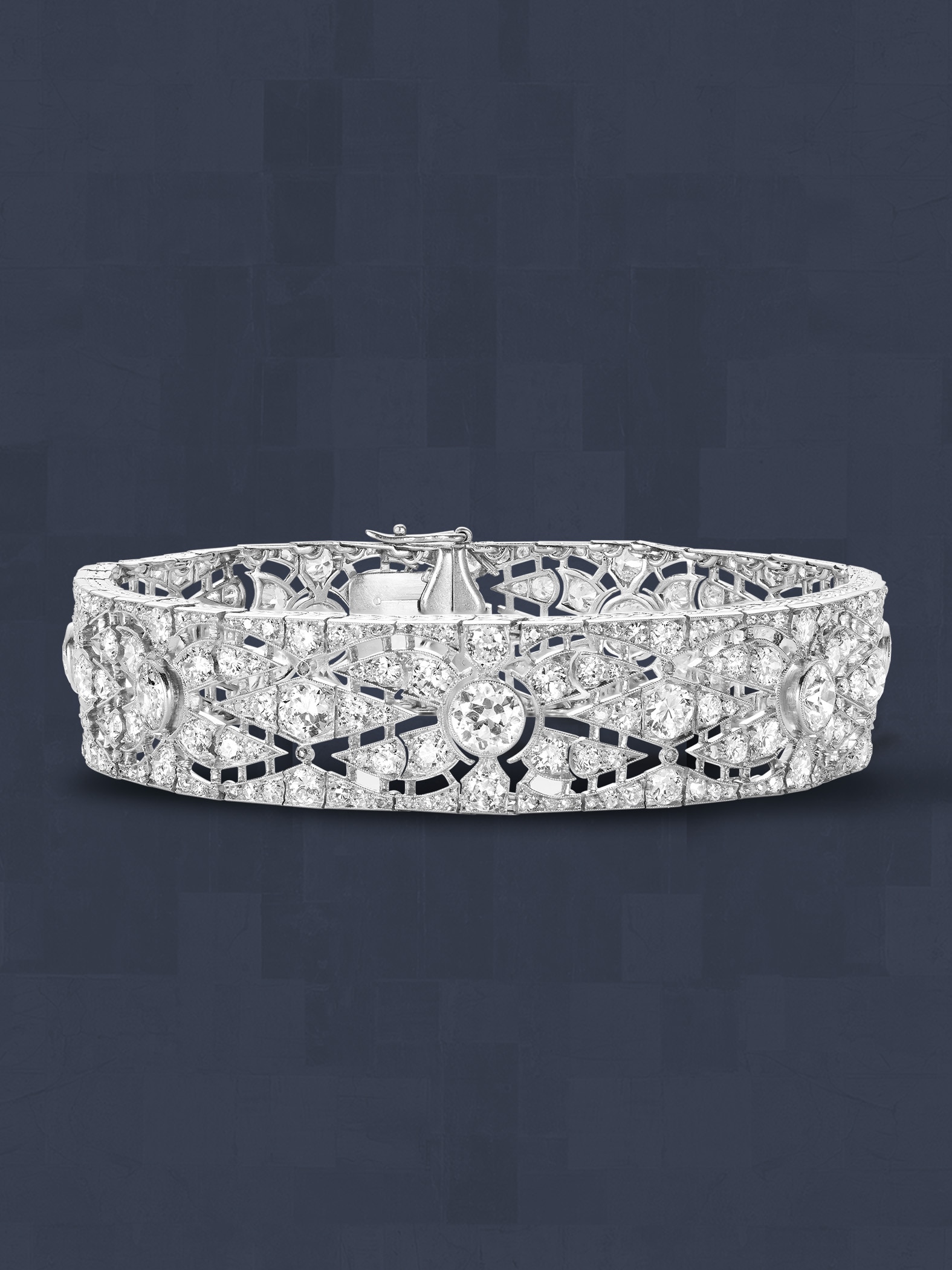
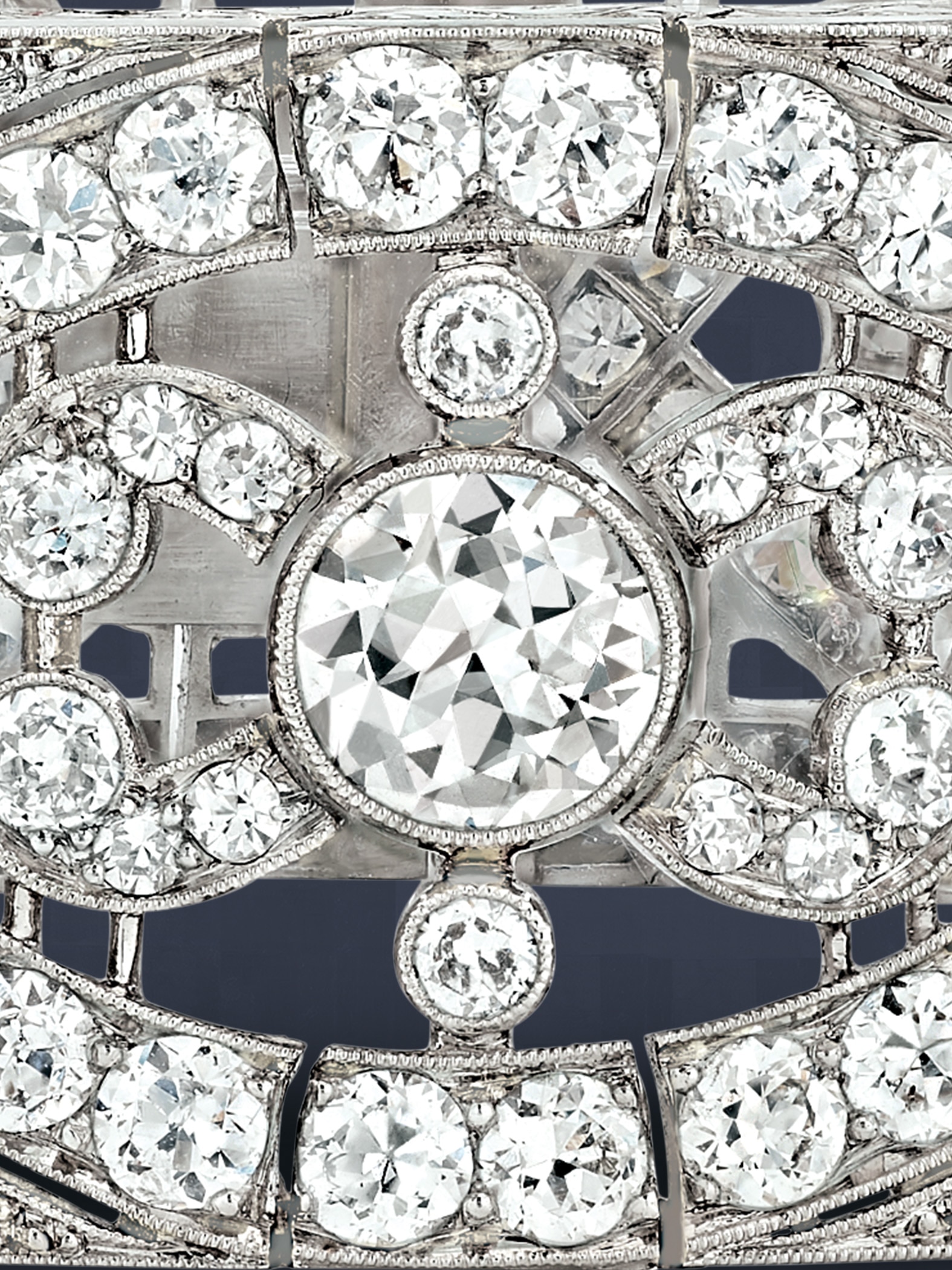
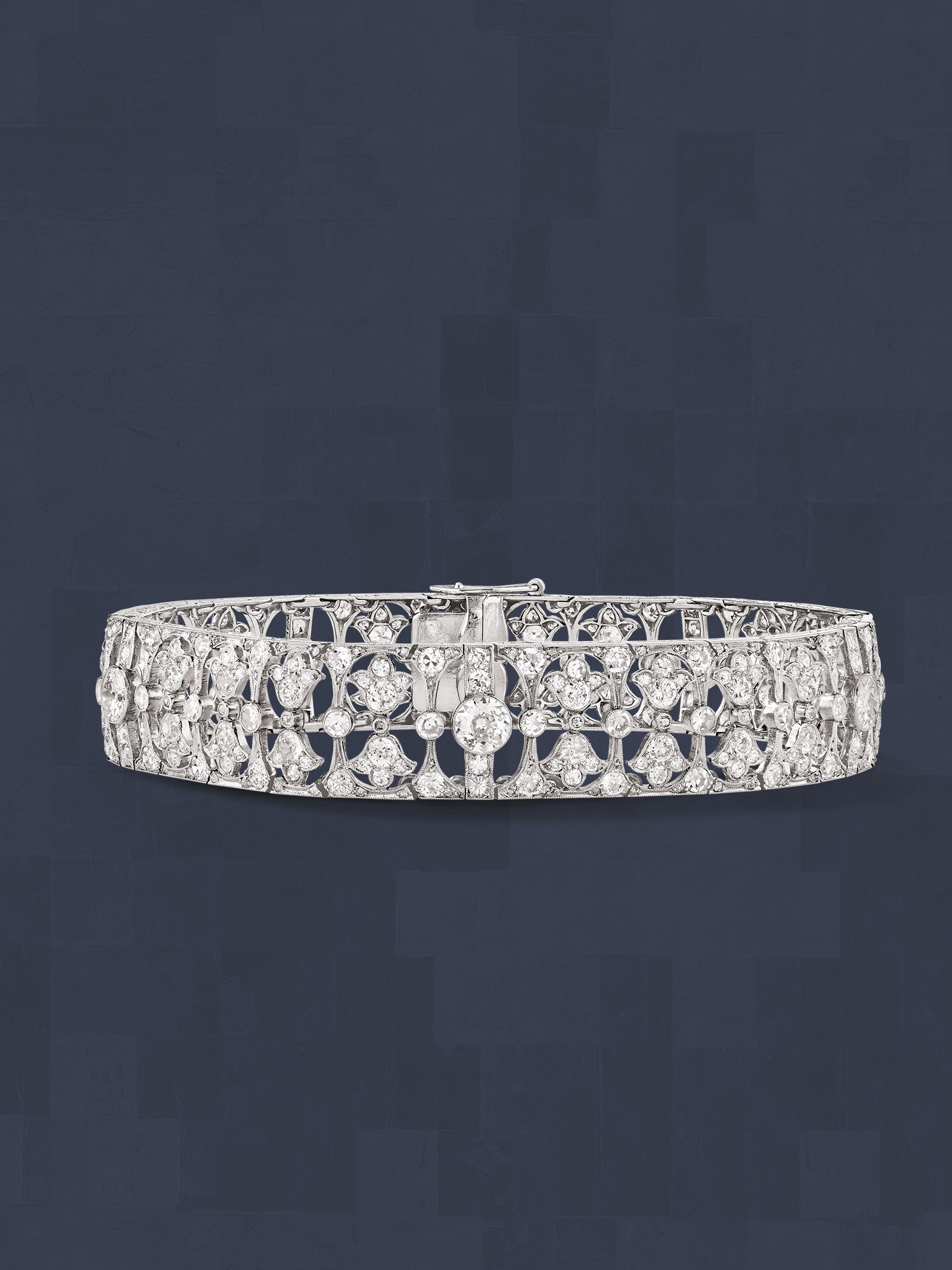
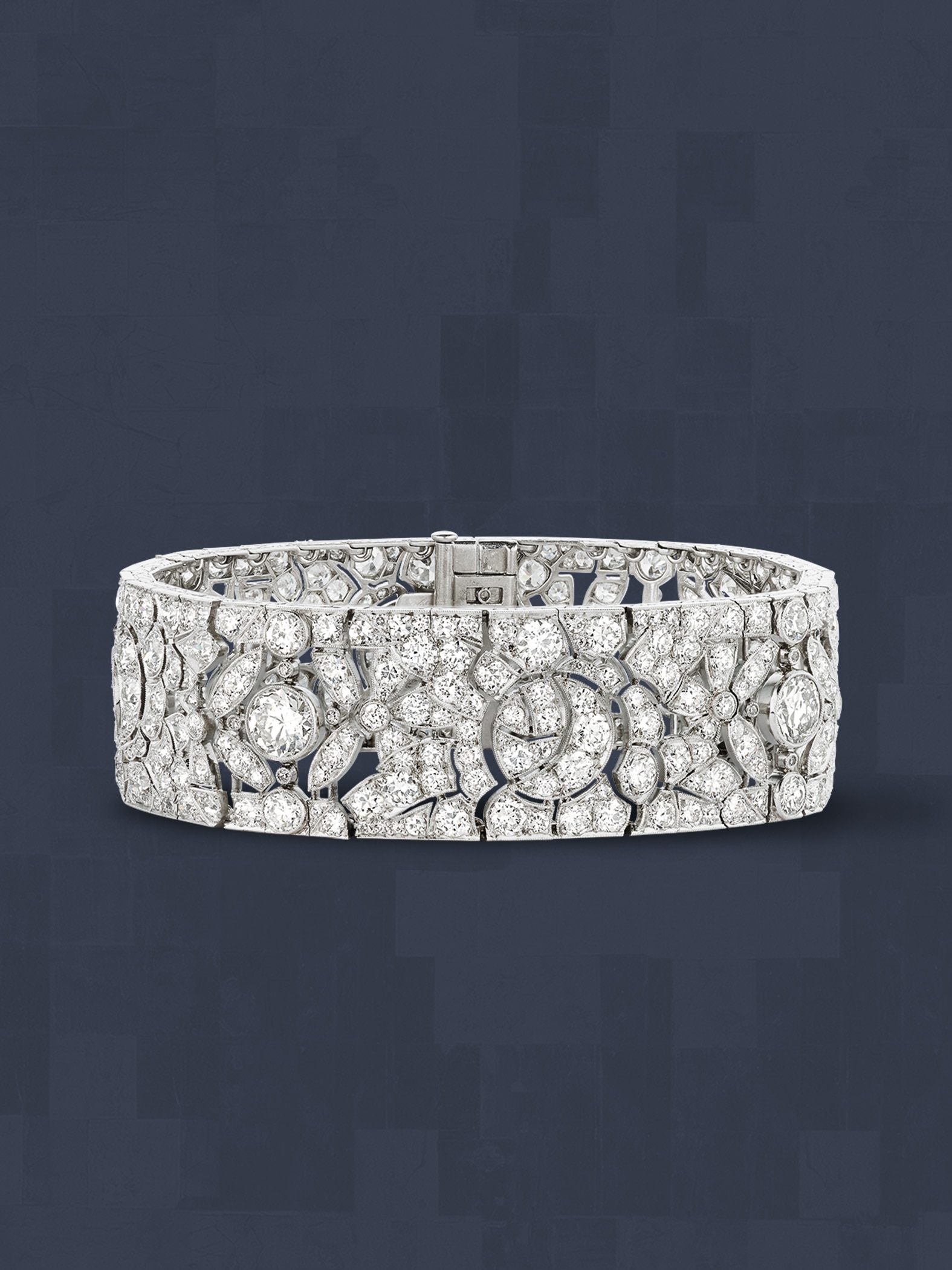
During the Art Deco period, Van Cleef & Arpels also unveiled diamond-set band bracelets, representative of the Maison's taste for white jewelry in the 1920s. These bracelets, with their flexible structure, are recognizable by their stylized, repeated, and monochrome motifs. They offer different volumes and a sense of perspective to the pieces.


These motifs resonate with Gustav Klimt's preparatory drawings for the Stoclet Frieze, which offer an immediate insight into the artist's creative process. These sketches illustrate Klimt's aspiration to combine art, ornament, and architecture into a single, unified work.

Band bracelets from the 1920s
Bracelets, 1922-1925. Platinum, diamonds. Van Cleef & Arpels Collection.
Gustav Klimt. Working drawings for the dining hall frieze of Stoclet House with the motif Fulfilment (Lovers), 1908–1911. Pencil, colored pencil, gouache; bronze, silver, and gold powder. MAK.

Gustav Klimt 

Working drawings for the dining hall frieze of Stoclet House with the motif Fulfilment (Lovers), 1908–1911

Pencil, colored pencil, gouache; bronze, silver, gold powder 

MAK

On Stage

On Stage

Since its foundation in 1906, Van Cleef & Arpels has created jewelry and accessories for opera and theater enthusiasts, while considering the customs of appearance and, notably, all the associated finery. This artistic connection is further echoed in Vienna's vibrant cultural history, with the MAK Collection preserving a wealth of artifacts related to its celebrated music, theater, and dance traditions.


Modern dance became an established art in the Austrian capital, playing a key role at Cabaret Fledermaus opened in 1907. Decorated by the Wiener Werkstätte under the direction of Josef Hoffmann, this avant-garde cabaret welcomed renowned artists, including the dancer Gertrude Barrison. The cabaret's first program featured an illustration by Fritz Zeymer, capturing the dancer's grace.

Little Winged Fairy clip, later named Spirit of Beauty, 1941. Platinum, emeralds, rubies, diamonds. Purchased by the American socialite Barbara Hutton for a friend. Van Cleef & Arpels Collection.

Little Winged Fairy clip, later named Spirit of Beauty, 1941

Platinum, emeralds, rubies, diamonds

Purchased by the American socialite Barbara Hutton for a friend

Van Cleef & Arpels Collection

Fritz Zeymer. Illustration for the 1st program of Cabaret Fledermaus (dancer Gertrude Barrison), Vienna, 1907. India ink, gouache. MAK.

Fritz Zeymer 

Illustration for the first program of Cabaret Fledermaus (dancer Gertrude Barrison), Vienna, 1907

India ink, gouache

MAK

Fairy clip, 1943. Platinum, emeralds, rubies, diamonds. Van Cleef & Arpels Collection.

Fairy clip, 1943

Platinum, emeralds, rubies, diamonds

Van Cleef & Arpels Collection

Inspired by performance arts, the Maison introduced Dancer and Fairy clips in 1941, reflecting ballet passion and a dreamlike universe. Fairies, such as the one featured on the Little Winged Fairy clip, embody the Maison’s enchanting world.


Attached to the art of dance, opera, or theatre, the Maison has accompanied women and artists throughout the decades with jewelry pieces and precious accessories.

Evening bag, 1923. Platinum, pearls, diamonds. Van Cleef & Arpels Collection.

Evening bag, 1923

Platinum, pearls, diamonds

Van Cleef & Arpels Collection

Lapel watch, 1926. Platinum, white gold, sapphires, onyx, diamonds.Van Cleef & Arpels Collection.

Lapel watch, 1926

Platinum, white gold, sapphires, onyx, diamonds

Van Cleef & Arpels Collection

Necklace, 1936. Platinum, white gold, rubies, diamonds. Van Cleef & Arpels Collection.

Necklace, 1936

Platinum, white gold, rubies, diamonds

Van Cleef & Arpels Collection

Five-leaf clip, 1965. Platinum, rubies, diamonds. Former collection of opera singer Maria Callas. Van Cleef & Arpels Collection.

Five-leaf clip, 1965

Platinum, rubies, diamonds

Former collection of the opera singer Maria Callas

Van Cleef & Arpels Collection

Metamorphoses

Metamorphoses

The concept of metamorphoses and transformation is a recurring and celebrated theme in both jewelry and applied arts. This is evident in Van Cleef & Arpels' innovative transformable creations and trompe-l'oeil designs. Similarly, the MAK Collection showcases numerous metamorphic objects, from multi-functional pieces to repurposed historical jewelry, highlighting the artistic evolution of form and function.

Ribbed necklace, 1972-1984, from Van Cleef & Arpels Collection

Ink standish, circa 1620, from the MAK

The 1972 Ribbed necklace once again testifies the Maison's perpetual taste for convertible pieces. Composed of engraved chrysoprase motifs separated by gold and diamond bows, it features detachable elements and can be changed into a bracelet. It is associated with an ivory ink standish, acquired by the MAK in 1892. It illustrates the aspiration of early modern cabinets of curiosities to unite artisanal virtuosity with aesthetic design. At first glance, the slender, tower-like structure is reminiscent of an architectural model. Only upon closer inspection does the object's actual function reveal itself.


Inspired by the universe of couture, Van Cleef & Arpels has also designed numerous white gold and diamond clips, imitating the movement and fluidity of fabrics and ribbons. Timelessly elegant, the voluminous 1937 double clip converts into two separate clips. It is displayed alongside a late 19th-century tablecloth from the MAK’s Textiles and Carpets Collection, which features a diamond grid consisting of blue flower tendrils with ribbons and bows, on white background.

Tablecloth. Goodyer’s Artistic Fabrics, England, late 19th century. Cotton, printed. MAK.

Tablecloth

Goodyer’s Artistic Fabrics, England, late 19th century

Cotton, printed

MAK

Double clip, 1937. Convertible into two clips. Platinum, osmior, diamonds. Van Cleef & Arpels Collection.

Double clip, 1937

Convertible into two clips

Platinum, osmior, diamonds

Van Cleef & Arpels Collection

Nature & Cosmos

Nature & Cosmos

The exhibition closes with an homage to the beauty of nature and the universe. The enduring influence of flora, fauna, and cosmic elements on artistic creation is a central theme. This is exemplified by Van Cleef & Arpels' diverse designs, from realistic flowers to celestial motifs and anthropomorphic clips. Such inspirations are also deeply rooted in broader applied arts, as seen in the extensive MAK Collection and historical artifacts.


The Leaf bracelet, created by Van Cleef & Arpels in the 1950s, features a stylized, curved leaf motif paved with sapphires on yellow gold, with veins in polished gold or platinum set with diamonds. This piece extends the tradition of floral iconography in the French jewelry arts while simplifying the natural forms seen in 18th and 19th century pieces.


The bracelet echoes the Wiener Werkstätte fabric Leaves, designed by Martha Alber. This very popular fabric, with its expansive patterns and rich colors, is part of a collection of creations developed by women artists for the fabric and Wiener Werkstätte's fashion department.

Leaf bracelet, 1950. Platinum, yellow gold, sapphires, diamonds. Former collection of the American socialite Marjorie Merriweather Post. Van Cleef & Arpels Collection.

Leaf bracelet, 1950

Platinum, yellow gold, sapphires, diamonds

Former collection of the American socialite Marjorie Merriweather Post

Van Cleef & Arpels Collection

Wiener Werkstätte fabric pattern Blätter (Leaves) (Hard proof), 1910-11. Block print. MAK.

Wiener Werkstätte fabric pattern Blätter (Leaves) (Hard proof), 1910-11

Block print

MAK


The Mystery Set™, a technique patented by the Maison in 1933, underscores the preciousness of nature. The Flower clip from 1938 is set with emeralds while the Bellflower clip presents a flower in Mystery set sapphires. It contrasts with the diamond and creates a play of oppositions.

The cosmos has often inspired the Maison to create stylized forms of great modernity, exemplified by the Meteor wristwatch from 1959. It combines asymmetrical yellow gold strands with diamond centers, while the Asterisk piece uses textured gold to convey the rays and movement of a twinkling star.

Flower brooch, 1938. Platinum, white gold, yellow gold, Mystery Set emeralds, diamonds. Van Cleef & Arpels Collection.

Flower brooch, 1938

Platinum, white gold, yellow gold, Mystery Set emeralds, diamonds

Van Cleef & Arpels Collection

Bellflower clip, 1969. Platinum, yellow gold, Mystery Set sapphires, diamonds. Van Cleef & Arpels Collection.

Bellflower clip, 1969

Platinum, yellow gold, Mystery Set sapphires, diamonds

Van Cleef & Arpels Collection

Meteor secret wristwatch, 1959. Yellow gold, platinum, diamonds. Van Cleef & Arpels Collection.

Meteor secret wristwatch, 1959

Yellow gold, platinum, diamonds

Van Cleef & Arpels Collection

Asterisk clip, 1966-1967. Yellow gold, platinum, white gold, rose gold, sapphires, diamonds. Van Cleef & Arpels Collection.

Asterisk clip, 1966-1967

Yellow gold, platinum, white gold, rose gold, sapphires, diamonds

Van Cleef & Arpels Collection

The project is the result of an intensive collaboration and inspiring discourse between two institutions that are united by their shared enthusiasm for outstanding designs, exceptional craftsmanship, and visionary ideas.


Visitors will embark on a journey of discovery through the entire spectrum of the decorative arts.

Practical information

Location

MAK Exhibition Hall

Stubenring 5, 1010 Vienna, Austria


GET DIRECTION

Opening hours

From June 10th to September 27th, 2026

Wednesday to Sunday from 10:00am to 06:00pm

Tuesday from 10:00am to 9:00pm

Entrance fee

€19 - €18*

Reduced €15.50 - €14.50*

Every Tuesday 6:00pm to 9:00pm: admission €9.50 - €8.50*

Free admission for children and teens under 19

*Online ticket price


Registration here