Coming Soon
Conversing Colours
A co-curated exhibition between the Hong Kong Museum of Art and
Van Cleef & Arpels
From 1 December 2026 to 5 April 2027
Conversing Colours
A co-curated exhibition between the Hong Kong Museum of Art and
Van Cleef & Arpels
The exhibition Conversing Colours invites visitors on a contemplative journey through the five cardinal colours of Chinese tradition — red, qing (blue-green), yellow, white, and black — which form the framework for an unprecedented dialogue between the collections of the Hong Kong Museum of Art and the Van Cleef & Arpels Patrimonial Collection.
From December 1st, 2026, to April 5th, 2027, colour will be explored as concept, material, and luminous phenomenon all at once, and will reveal deep resonances between Eastern and Western cultures.
Enriched by loans from the Musée des Arts Décoratifs in Paris and the Musée des Confluences in Lyon, this exhibition offers to rediscover colour as the most intimate of languages— one that transcends time, borders, and the boundaries of imagination.
RED
RED
In the Five Elements theory of traditional Chinese philosophy, the colour red is directly associated with the Fire element, which corresponds to the South and the summer season. This fiery hue as a symbol of good fortune, joy and passion; it is the most iconic colour of Chinese culture. Western Antiquity regarded red as the colour of power and magnificence.


In Jewelry, red is primarily associated with the ruby. Owing to its rarity in Europe, this gemstone—and by extension its colour—was especially prized on the continent. The Chrysanthemum clip was created using the Mystery Set™, which has been central to the history of Van Cleef & Arpels since 1933.
By using parallel metal rails and eliminating any visible setting, Mystery Set™ technique made it possible, for the first time, to create perfectly continuous gem-set surfaces. This pursuit of a pure, unbroken colour finds a striking parallel in the Langyao red glaze of the Qing dynasty. Known as oxblood red, this glaze is equally defined by its seamless, heavily glassy surface and its intense, vivid crimson hue — a depth of colour achieved not through stone, but through the controlled fluidity of glaze during firing.

Carved red lacquer box cover with phoenix design
Qianlong period (1736–1795), Qing dynasty
Lacquer
Collection of Hong Kong Museum of Art
Designed in 1924, this perfume bottle reuses a Chinese snuff bottle in "Peking lacquer", a term then employed in the West to describe carved red lacquers imported from China and sold in Paris through specialised galleries. This perfume bottle recalls the 18th-century practice of objets montés, whereby imported Chinese works were enhanced with gilt-bronze mounts. In Jewelry, particular attention was paid to the Asian use of jade, coral, enamel, and pearls to achieve distinctive chromatic effects.
The wave of chinoiserie that swept through France during this period thus encouraged the exploration of contrasts in materials, colours, and tonal values that became hallmarks of the Art Deco style.

Almond tree bracelet, 1999
Yellow gold, jasper, malachite, coral, diamonds
Van Cleef & Arpels Collection
From the Art Deco period onwards, coral was added to the Van Cleef & Arpels' stone repertoire. Throughout the Mediterranean world, this organic material has historically been credited with apotropaic properties. Its rich palette, from light pink to vivid orange allowed the Maison to play with contrats on this bracelet.

Plate decorated with red design, 19th century
Porcelain
Collection of Musée des Confluences, Lyon
This plate was for a long time attributed to China. This confusion is most certainly the result of the renumbering of a part of the Asian collections at the Musée Guimet de Lyon. It is now identified as a French creation, produced by the Samson Manufactory. This factory was one of the leading French manufacturers specializing in the reproduction of Asian porcelain during the nineteenth century.
QING
QING
(BLUE / GREEN)
In ancient China, “qing” (青) or “turquoise” was a general term for a range of shades; it corresponds to Wood in the Five Elements theory, with connotations of the East and the spring season. Ancient association of this hue to spring, the season of revival, informs its positive symbolic values as a token of vitality, youth, vigour and hope.
The Ming and Qing dynasties (1368-1911) continued to build on this artistic tradition to capture idyllic beauty, a pursuit widely reflected in decorative arts in blue-green shades, making them popular both at court and among the common people.


Artisans showcased the beauty of the blue-green shades through the finest craftsmanship, whether in Tian-tsui style featuring kingfisher feathers or through blue-glazed ware fired using different colouring agents, such as works in vitreous melon-green glaze on this plate with carved dragon and phoenix, or purplish aubergine glaze.
Since the Middle Ages, blue has been regarded as one of the most highly esteemed colours in the Western world, whereas the appreciation of green has remained more ambivalent.
On the 1950 cigarette table case, the spread tail of the peacock is described thanks to translucent blue and green enemal on a cloisonné surface.
Swipe to discover

Ewer
Six-character mark of Qianlong and of the period (1736 – 1795), Qing dynasty
Ceramics
Collection of Hong Kong Museum of Art
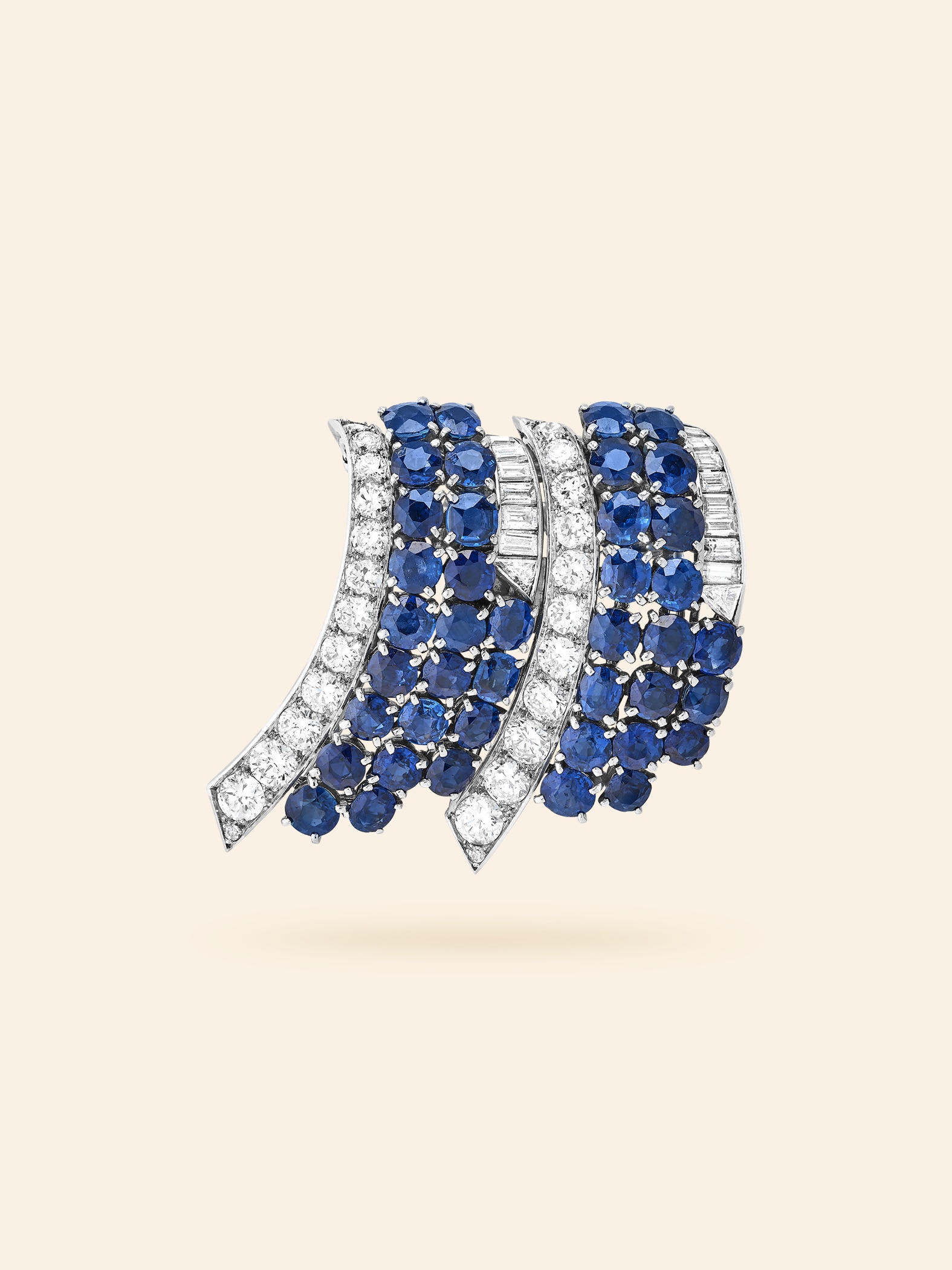
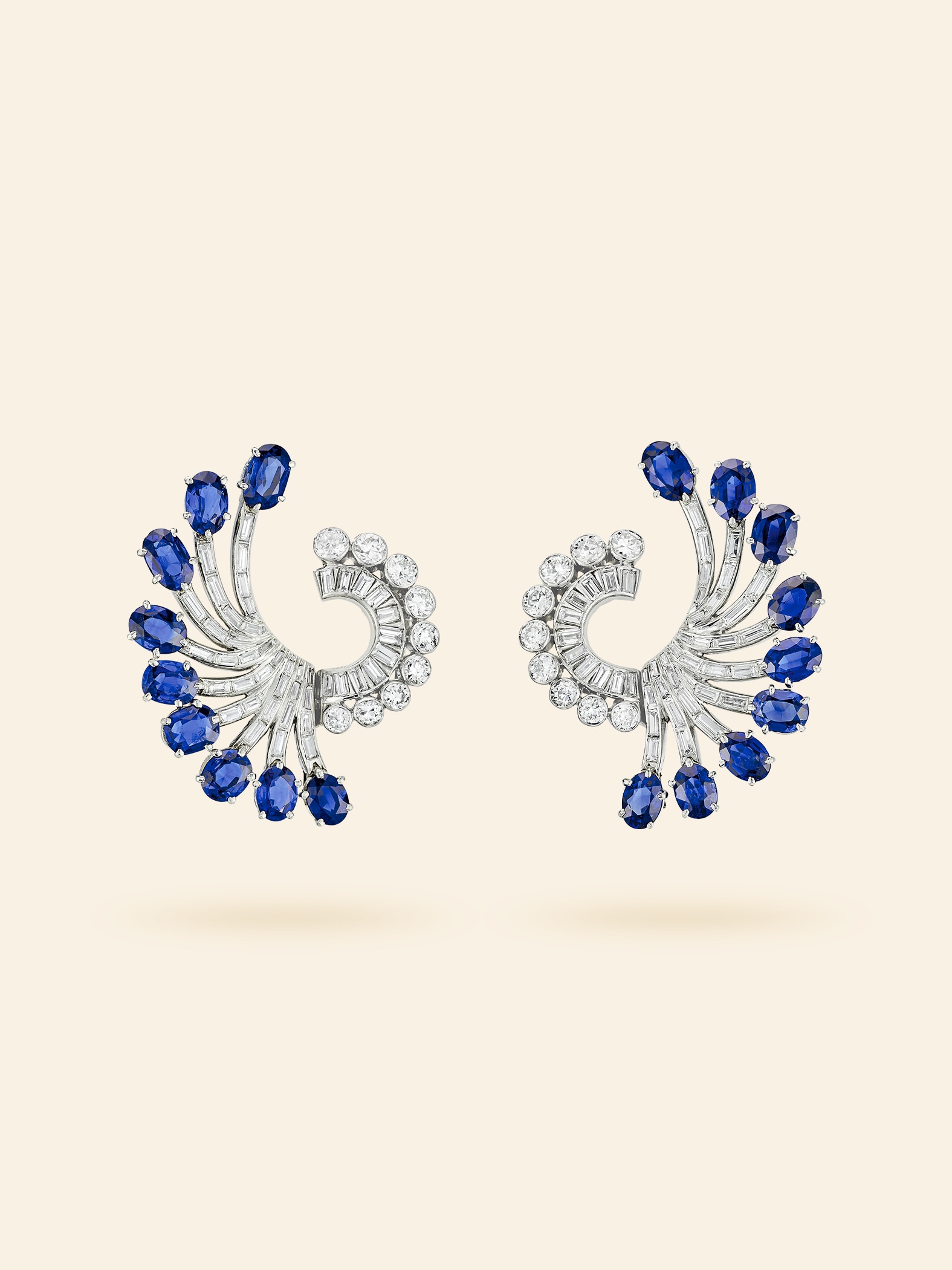
In France, blue has long symbolised monarchy, while green has been linked to love, luck, and chance. In European jewelry, sapphires represent nobility and emeralds — since the 17th century — faithful love.
Both stones dominated fine Jewelry throughout the 20th century, often paired with diamonds. The Art Deco movement of the 1920s, and again a colourful revival in the 1970s, broadened the palette to include turquoise, lapis lazuli, aquamarine, chalcedony, and jade. Enamel also offered an enduring alternative for achieving these shades.

Pelouse Bagatelle necklace, 1960-1965
Yellow gold, rose gold, sapphires, turquoise, diamonds
Van Cleef & Arpels Collection

Lady’s headdress (tianzi), Qing dynasty (1644–1911)
Kingfisher feather, pearls and semi-precious stones
Collection of Hong Kong Museum of Art

Pelouse Bagatelle ring,1960-1965
Yellow gold, rose gold, sapphires, turquoise, diamonds
Van Cleef & Arpels Collection
Created in 1960, the Pelouse Bagatelle necklace and ring reflects the renewed popularity of turquoise, a gemstone distinguished by its cerulean-blue colour, in jewelry from the 1950s onwards. The gemstone’s distinctive colour lends itself particularly well to combinations with diamonds and other precious stones. On these creations, the cyan surface is enlivened by small floral motifs alternately set with diamonds and sapphires of a deeper blue. Launched as early as 1948 and still produced throughout the 1960s, Pelouse pieces resulted from an innovation patented by Van Cleef & Arpels to create continuous gem-set surfaces on flexible jewels.

Table clock, 1930
Yellow gold, lapis lazuli, onyx, turquoise, enamel
Van Cleef & Arpels Collection
Created in 1930, this functional and decorative table clock reuses an antique Chinese turquoise snuff bottle carved with the figure of a woman framed by vegetal motifs, fitted with a blue-enamelled yellow gold collar to display the hours and mounted on a stepped onyx base accented with lapis lazuli and yellow gold.

Necklace, 1971-1973
Yellow gold, jade, lapis lazuli, diamonds
Van Cleef & Arpels Collection
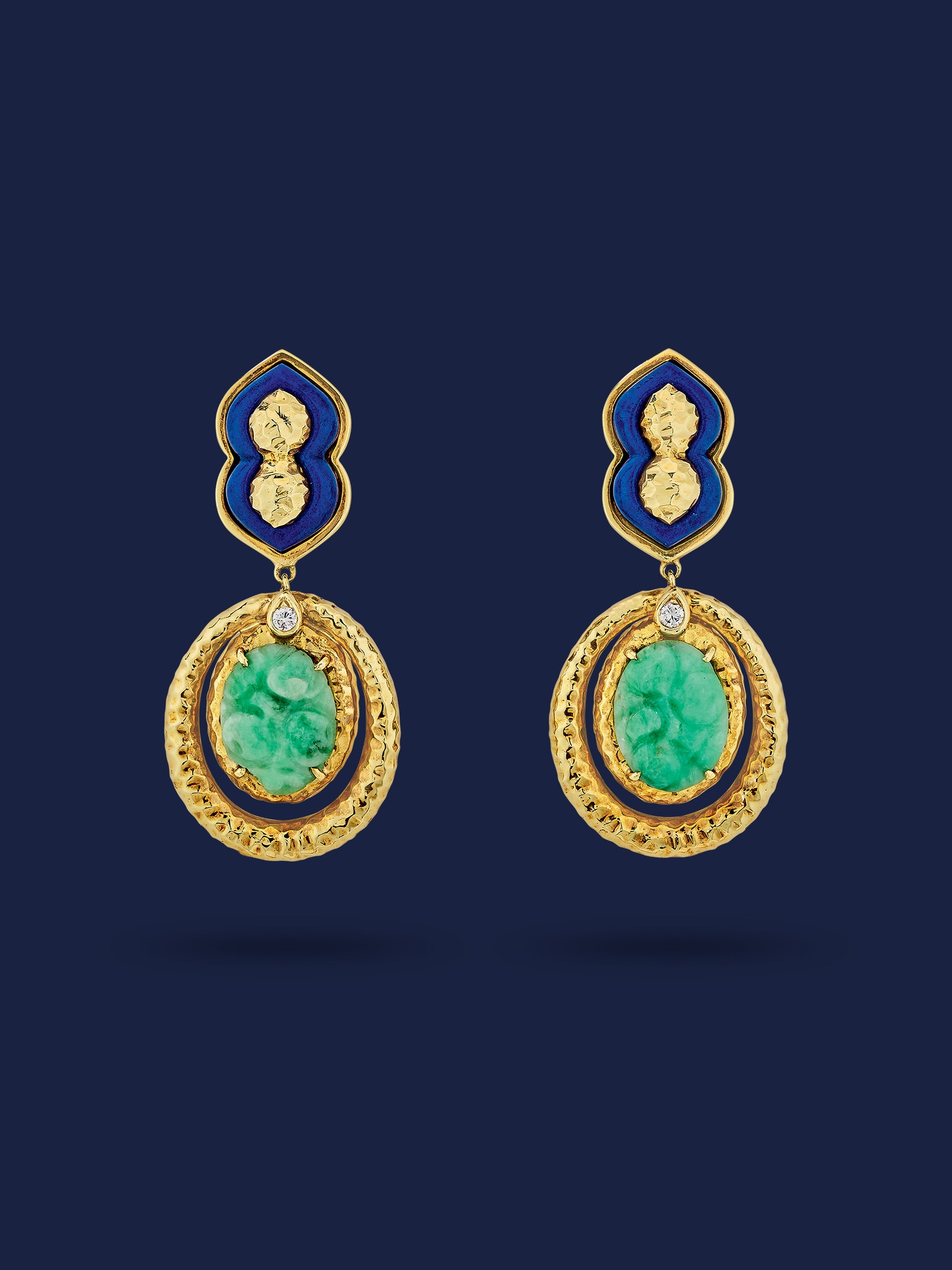
This ensemble reflects the growing interest in Asian art within Western Jewelry design during the 1970s. Carved jade elements, acquired by Van Cleef & Arpels as decorative components, are combined with lapis lazuli and textured yellow gold.
Long prized in China for its colour, translucency, and polished surface, jade—particularly green jade—became closely associated with Asian art in the West. Created between 1971 and 1973, these creations also reflect the decade’s renewed interest in Art Deco and the artistic traditions of the 1920s.

Ballerina clip, 2010
White gold, sapphires, chalcedony, diamonds
Van Cleef & Arpels Collection
Depicted "en pointe", this 2010 Ballerina clip elegantly raises her arms. Her tutu echoes the forms and textures of 18th- and 19th-century stage costumes, as her two-layered skirt, features buff-topped chalcedony, is framed by bands of diamonds accented with sapphires. Luminous and consistent in colour, the chalcedony was carefully cut and polished to evoke voluminous, soft fabric as well as petals and highlight its deep blue shade.
YELLOW
YELLOW
The colour yellow corresponds to the Earth element; it denotes the center and the period from late summer to early autumn. Yellow had been the imperial colour for emperors from the Tang dynasty (618-907) onward, symbolising authority and superiority. The ancient Chinese had a long history of using colours to represent and distinguish social class and status.


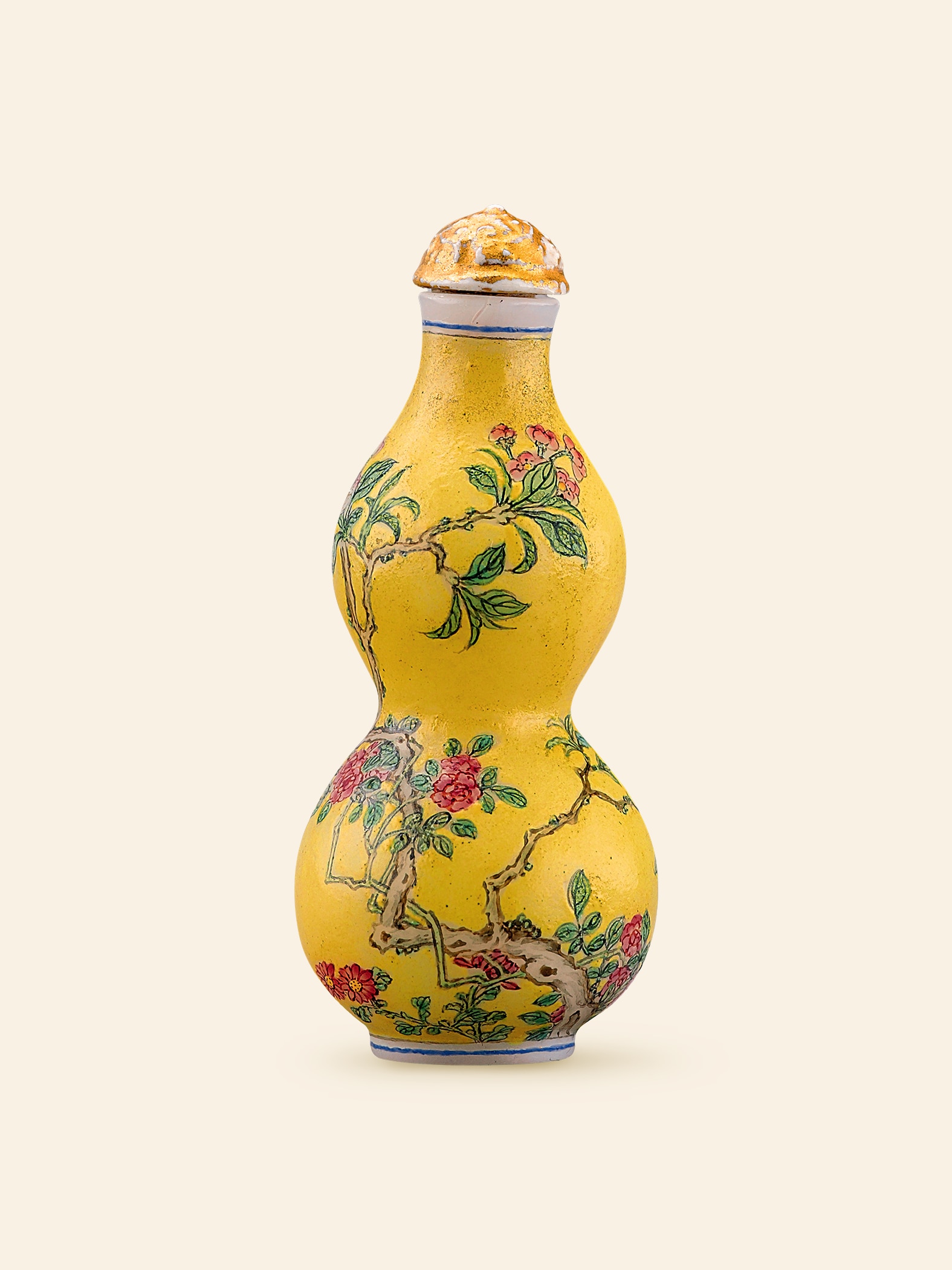
Created in 1971 to hold a 96.62-carat yellow briolette diamond formerly belonging to opera singer Ganna Walska, this Bird clip sets the luminous stone in a bird's beak, its plumage paved with deeper yellow-to-brown diamonds in a harmonious palette of warm golden tones. Beyond its aesthetic refinement, the piece exemplifies Van Cleef & Arpels' mastery of transformable Jewelry — the wings detach as earrings, the tail as an independent clip, and the briolette as a pendant — a technical virtuosity that finds an echo in the demanding art of painted enamel on glass snuff bottles at the Qing imperial court, as applying enamels on a glass body was more challenging than on metal.

Necklace transformable into two bracelets, 1966-1975
Yellow gold, white gold, rose gold, peridots, diamonds
Van Cleef & Arpels Collection
From Antiquity onwards, yellow has been associated with the sacred and with wealth. Gold, a naturally yellow metal, has been mined, sought after, and worked in Europe for the production of personal adornments since the fifth millennium BCE.
A wide range of techniques has been applied to it, including engraving, openwork piercing, casting, enamelling, and lacquering. Among gem materials, topazes, citrines, sapphires, and diamonds occur in a variety of yellow hues.

Bracelet, 1966-1975
Yellow gold, white gold, rose gold, peridots, diamonds
Van Cleef & Arpels Collection

Earrings with detachable pendants, 1966-1975
Yellow gold, white gold, rose gold, peridots, diamonds
Van Cleef & Arpels Collection

Ring, 1966-1975
Yellow gold, white gold, rose gold, peridots, diamonds
Van Cleef & Arpels Collection
One possible etymology of the word topaz derives from the Sanskrit topas, meaning "fire", reflecting the gemstone’s colour range from yellow to orange. Among all coloured gemstones, the yellow diamond—also known as the jonquille diamond—occupies a particularly prominent place in the artistic history of the Maison.

Necklace, 1958
Yellow gold, platinum, topazes, diamonds
Van Cleef & Arpels Collection
In 1958, Van Cleef & Arpels created this necklace using thirteen topazes for 71,66 carats from the client. Carefully matched for colour, the emerald-cut gems display rich golden-yellow hues, enhanced by their deep cuts and warm yellow gold settings.
Particularly appreciated for its luminous tones, topaz was often paired with yellow gold, whose warmth intensifies its colour. Regarded as a so-called "fancy" gemstone rather than one of the traditional precious stones, topaz became increasingly uncommon in Jewelry during the 1950s, making this necklace a remarkable testament to its legacy.

Wall clock “au Chinois”, 1740
Gilt bronze, enamel dial, glass
Collection of Musée des Arts Décoratifs, Paris
Installed in aristocratic townhouses as a conspicuous sign of wealth, this 18th-century wall clock reflects the growing European fascination with China. Rather than faithful imitations, these chinoiseries favoured fanciful reinterpretations of Asian motifs, with bronze proving particularly well suited to their elaborate forms.
On this wall clock, characteristic elements — foliage, a hat, and a parasol — evoke the Chinese-inspired iconography that captivated European decorative arts throughout the century.
WHITE
WHITE
Across cultures and centuries, white has held a singular place in the world of beauty and symbolism.
In China, it embodied purity and imperial refinement, elevated through the luminous surfaces of white jade and fine porcelain. In the West, its associations with immaculacy found expression in the diamond, the pearl, and the cool brilliance of platinum.
Distinct in tradition yet united by a shared sensibility, these two worlds converge around a single conviction: that white, far from an absence, carries its own quiet and enduring power.


A shared fascination runs through these two pieces: the art of giving form to legend through white matter.
In the dragon clip, white coral is carved with ribbed precision — its curves and spirals shaped with the hand of a sculptor, capturing the movement of a fantastical creature in full flight. The Figure of Two Immortals of Harmony and Union draws on the same sculptural sensibility.
The creamy, translucent porcelain of the Dehua ware lends itself naturally to fine engraving and expressive detail. In both pieces, a pale, luminous material becomes the medium through which myth and symbol take shape.

Cormorant brooch, 1927
Platinum, white gold, onyx, diamonds
Van Cleef & Arpels Collection

Duck brooch, 1921
Platinum, white gold, onyx, diamonds
Van Cleef & Arpels Collection

Crowned Crane brooch, 1921
Platinum, white gold, onyx, diamonds
Van Cleef & Arpels Collection
The plumage of each bird is meticulously fashioned in platinum, outlined with a delicate perlé decoration and entirely set with rose-cut and brilliant-cut diamonds. A single round onyx marks the position of each eye. They also exemplify the vogue for "white jewelry"—the combination of white metals and white gemstones, most notably platinum and diamonds—which became widespread in Western Jewelry during the first decades of the twentieth century.

Pampille earrings, 1924
Platinum, pearls, diamonds
Van Cleef & Arpels Collection

Jade plate carved with wannianqing and lingzhi design
Qianlong period (1736–1795), Qing dynasty
Jade
Collection of Hong Kong Museum of Art

Long necklace, 1967
Platinum, pearls, diamonds
Van Cleef & Arpels Collection
These three pieces are united by a luminous palette of whites and silvers, where light becomes a true material.
The earrings set two pearls — one white, one grey — within a precise diamond and platinum mount, their contrasting glow framed by cold, brilliant facets.
The jade plate offers a quieter contrast: valued for its gentle glow and rich, creamy texture, white jade lends the surface a soft, radiant depth, further revealed by delicate low relief carving.
The necklace brings movement to this dialogue, as pearls and diamonds fall together in a shimmering cascade.
BLACK
BLACK
Defined in the Shuowen Jiezi — the first systematic etymological dictionary of the Chinese language — as "the colour produced by smoke from fire", black has long embodied mystery, awe, and righteousness across Chinese culture, inspiring masterworks from Song dynasty black porcelain to Tixi lacquerware and Famille Noire Kangxi ware.
In the Western tradition, black carries equal symbolic weight — from Victorian mourning onyx to the bold chromatic contrasts of Art Deco Jewelry — while materials such as ebony, hematite, and grey mother-of-pearl further expanded its expressive range throughout the twentieth century.


A shared chromatic audacity unites these two pieces: on the Famille noire vase, flowers emerge in vivid colour against a deep black ground, their brilliance heightened by darkness — an effect echoed in the Rose de Noël clip, where grey mother-of-pearl displays a tone described as "petrol", with grey enlivened by violet and green iridescence, while the edges of the petals deepen towards black.
Beyond colour, both works reveal the same devotion to floral detail — in the lapidary's precise rendering of petals and stamens, as in the refined brushwork animating the vase's surface.

Minaudière, 1950
Yellow gold, silver, lacquer
Van Cleef & Arpels Collection

Bagatelle cigarette case, 1950
Yellow gold, silver, sapphires, lacquer
Van Cleef & Arpels Collection

Bagatelle lighter, 1951
Yellow gold, silver, lacquer
Van Cleef & Arpels Collection
The 1950 Bagatelle Minaudière's signature motif — gold daisies blooming against black lacquer — was swiftly transposed onto a coordinated suite of accessories: a Bagatelle cigarette case (1950), enriched with sapphires, and a Bagatelle lighter (1951), all in yellow gold, silver, and lacquer.
Together, these three pieces illustrate how a single decorative language could travel across forms, turning everyday objects into coherent expressions of the Maison's aesthetic.

Powder case, 1922
Yellow gold, enamel
Van Cleef & Arpels Collection
During the 1920s, Van Cleef & Arpels developed a series of yellow gold compacts decorated with enamel. These designs featured a variety of ornamental schemes, including monochrome, striped, radiating, and undulating patterns.
French Art Deco Jewelry favoured bold chromatic contrasts, and the pairing of black and white was often used either alone or in combination with vivid tones such as blue, green, or red to create striking tricolour compositions.
Location
Opening hours
Exhibition presented from December 1st, 2026, to April 5th, 2027
Monday to Wednesdays, Fridays: 10:00am - 6:00pm
Saturdays, Sundays and public holidays: 10:00am - 9:00pm
Christmas Eve and Lunar New Year's Eve: 10:00am - 5:00pm
Close on thursdays (except public holiday) and the first two days of the Lunar New Year