Half a century has passed since Van Cleef & Arpels, founded in France in 1906, opened its first boutique in Japan (1973). The Maison has always enjoyed a special connection with traditional Japanese art and culture. Today, this dialogue between the French decorative arts and ancient Japanese artistic craftsmanship continues.
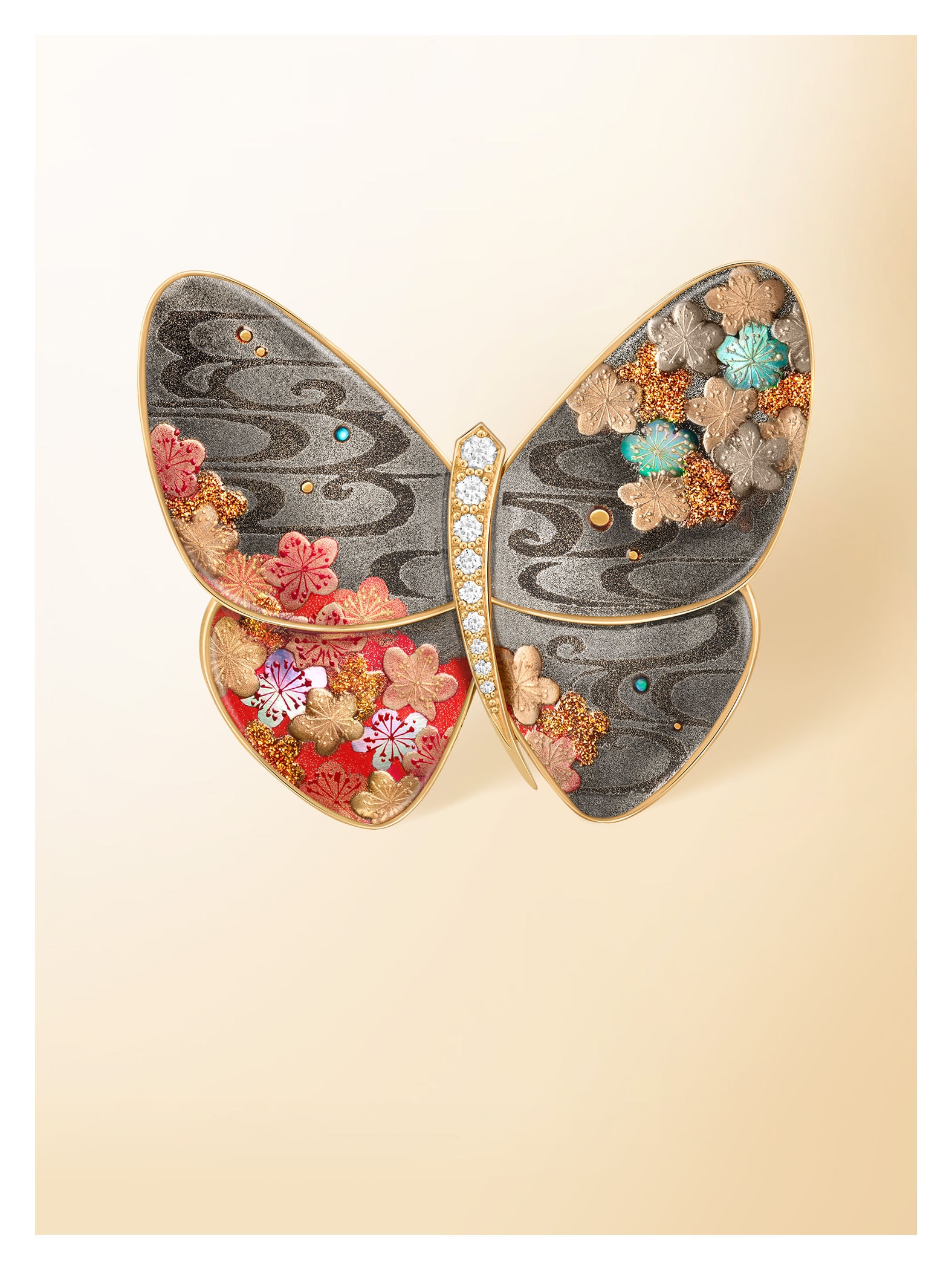
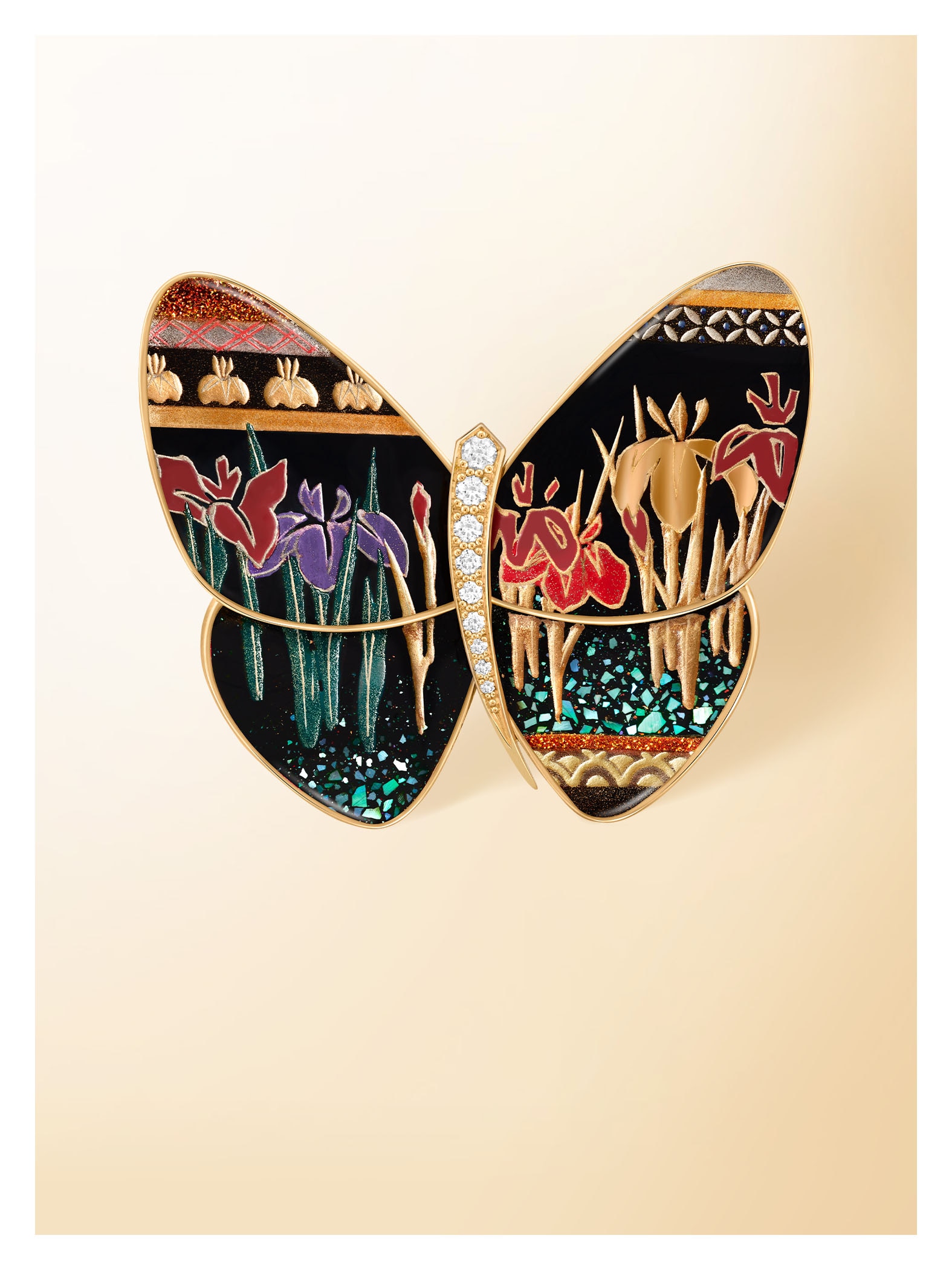
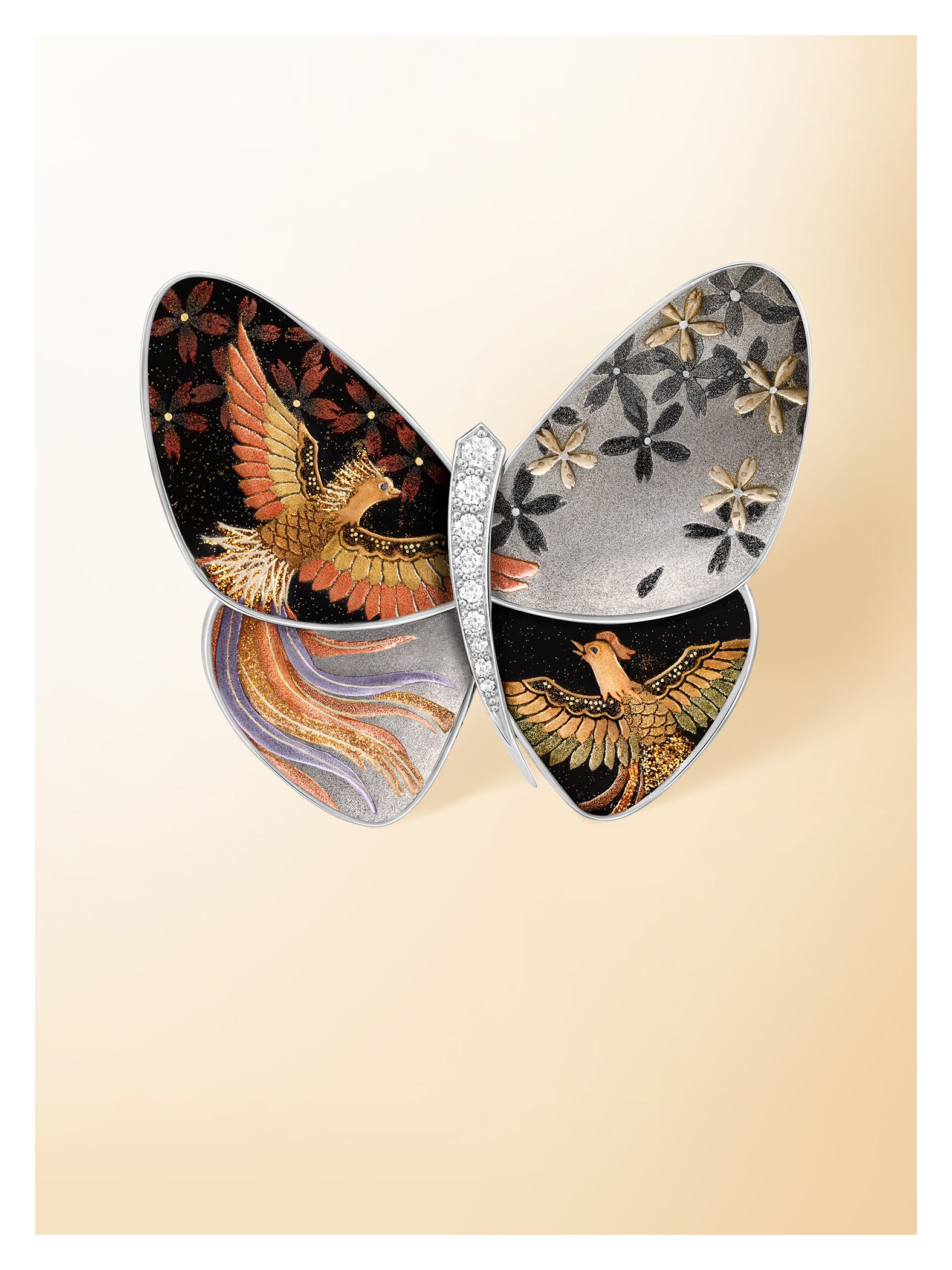
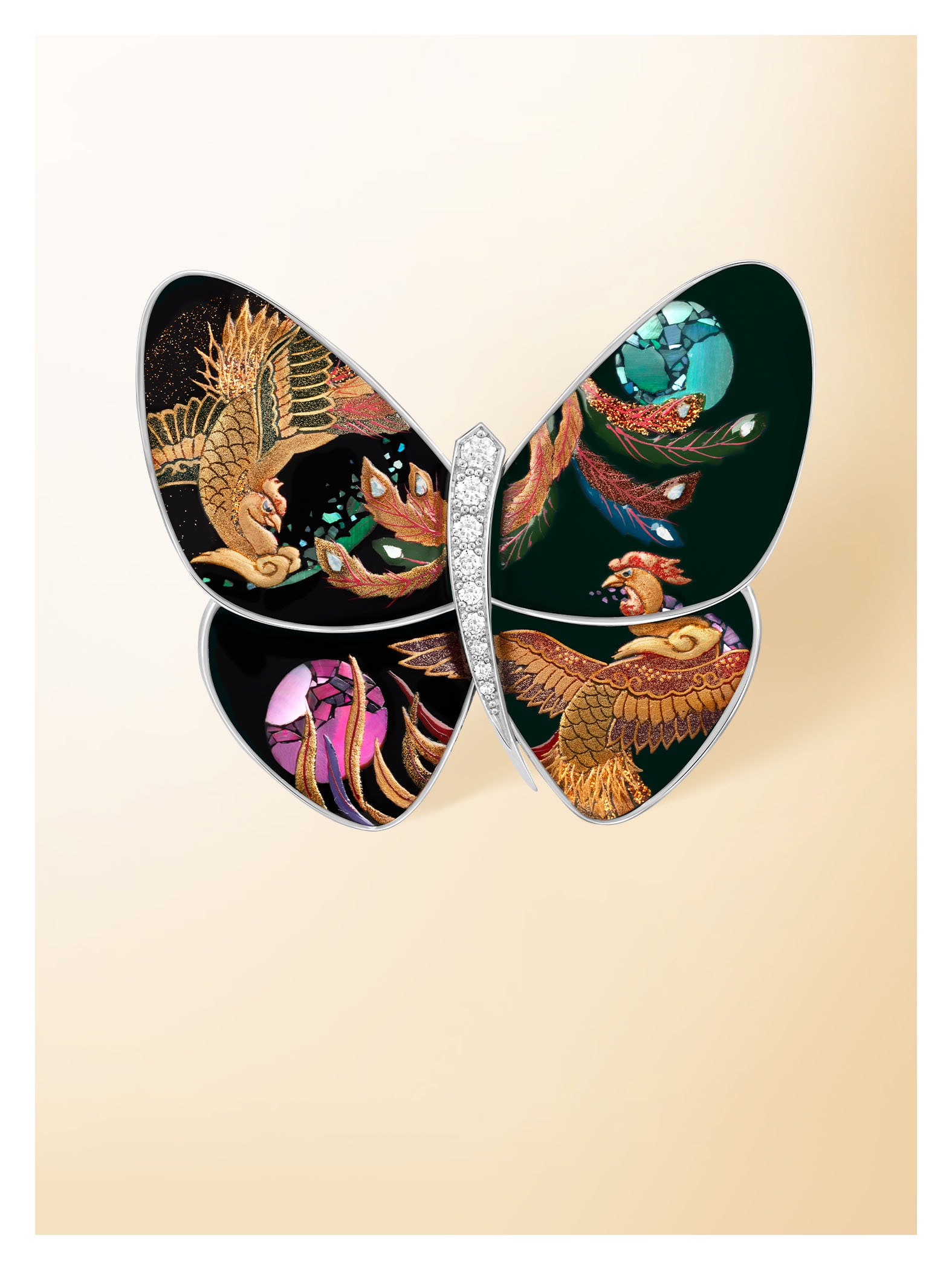
In 2004, one of Van Cleef & Arpels’ historical motifs, the butterfly, was reinterpreted in a new form: a lacquered Butterfly clip. This piece is the fruit of the Maison’s collaboration with Japanese artist Junichi Hakose. In his workshop, located in Wajima City, Ishikawa Prefecture, Mr. Hakose combines the area's traditional handicraft, Wajima-nuri, and his own vision of lacquer art.

Swipe to discover
Winged ballet
Nature has offered a rich and dearly cherished source of inspiration for Van Cleef & Arpels since its founding. Evoking a graceful and ethereal nature, butterflies have accompanied the Maison since its foundation. Always in movement, they gracefully fly in a beautiful ballet, to unveil joyful jewels. Various gems reflect their vivid and light-hearted allure.
For over hundred years, Van Cleef & Arpels has created butterflies of delicate shapes. In a flutter of wings, the Maison celebrates the plural beauty of such creatures.

Twilight clip, 1998
Yellow gold, white gold, lapis lazuli, diamonds
Van Cleef & Arpels Collection

Beaded Butterfly brooch, 1978
Yellow gold, white gold, rose gold, diamonds
Van Cleef & Arpels Collection

Butterfly brooch, 1975
Yellow gold, yellow diamonds, tiger's eye, diamonds
Van Cleef & Arpels Collection

Butterfly clip, 1974
Platinum, yellow gold, enamel, diamonds
Van Cleef & Arpels Collection

Butterfly clip, 1971
Yellow gold, wood
Van Cleef & Arpels Collection

Butterfly brooch, 1971
Yellow gold, white gold, malachite, diamonds
Van Cleef & Arpels Collection
Lacquered Butterflies: The fusion of two cultures
The encounter between Jewelry and traditional Japanese culture gave rise to a singular collaboration. After having been made – in France – from yellow and white gold, mother-of-pearl and diamonds, these butterflies are carefully hand decorated by Mr. Hakose with Japanese lacquer and maki-e technique. Each unique pattern of these limited-edition pieces is created on the butterfly wings through a sweeping sequence of techniques: from the Japanese lacquer to the decorations (maki-e, raden, rankaku and more), the lacquered butterfly is a long-term undertaking.
For the past 20 years, these lacquered butterflies have demonstrated continuous evolutions sparked by the dialog between these two cultures. As Mr. Hakose explains, "Europeans traditionally add new features, while Japanese have always tried to reduce or omit things. The outcome of this dialog is visible in the design of the lacquered butterflies. While Japan's culture has its own charm, I would like to understand French culture and facilitate communication."
Preeminent techniques to breathe life into vivid portrayals
Japanese techniques made it possible to transcribe butterflies' lively dance on such delicate and fine pieces. While eggshell fragments large and small must be meticulously arranged to form a specific pattern, the use of an ultra-thin brush to draw infinitesimally fine lines in a single stroke requires concentration and expertise. According to Mr. Hakose: “I had a hard time when drawing hand drums and balls. If the line is not taut and tense, it won’t work; it won’t feel alive. To achieve the result I want, the line should be not simply traced, but tightly pulled with the brush.”
Also, in the process where he creates motifs with finely crushed quail eggshells, Mr. Hakose skillfully arranges and adheres fragments, some barely larger than a speck of dust, to create a pattern. Among the pieces the Japanese artist creates, these lacquered butterflies, particularly diminutive, use various advanced techniques that interact to imbue their surfaces with dynamism and vitality.

maki-e: Technique in which patterns are drawn with lacquer on the surface. Gold powder is then sprinkled and fixed on the butterfly

rankaku: Technique in which eggshell marquetry is being used. For the Lacquered Butterflies, it is quail eggshells

raden: Technique in which linings of mother-of-pearl are cut into designs and inserted into the surface of the lacquerware.
Traditions rooted in the meeting of two cultures
French and Japanese craftsmanship share the idea of creating “objects that combine allure and functionality.” Just like jewelry, whose sparkle increases when worn, the beauty of lacquerware is also enhanced when used. In the words of Mr. Hakose, “Even when I draw a traditional pattern using traditional techniques, I want to make something current or something that will live in the future. That's what it means to pass down traditions.” As such, these lacquered butterflies, Mr. Hakose's first jewelry creations, offer a rare opportunity for a different country’s culture to stimulate Japan's traditions and encourage a quest for new aspects.
These lacquered butterflies, which are now flying all over the world, attest to the fruitful collaboration between Japan and France. In the future, they will certainly continue their metamorphosis, ever stimulating each other's traditions.

Junichi Hakose
Junichi Hakose is a Japanese lacquer artist from Wajima City, Ishikawa Prefecture. In 1975, he started an apprenticeship under the supervision of maki-e lacquer painting master Masaru Tanaka. Mr. Hakose began working independently after a five-year training period. He has mastered the techniques of lacquer painting, maki-e, and raden, becoming a master of contemporary lacquer expression based on his own sensibility.